Trump Signals Deal-Making Focus as China Summit Becomes Test of Domestic Pressure and Global Strategy
With political strain at home and a fragile global trade and security landscape, Trump enters Beijing seeking economic agreements with Xi Jinping rather than confrontation.
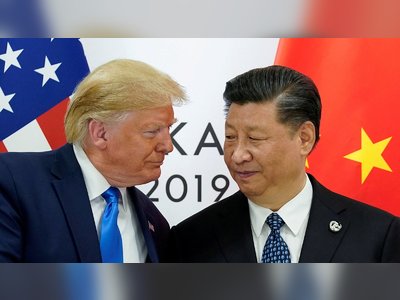
SYSTEM-DRIVEN dynamics in U.S.–China relations are shaping a high-stakes diplomatic summit in Beijing, where President Donald Trump is signaling a preference for negotiated economic deals over escalation with President Xi Jinping.
The meeting comes after months of trade friction, technological restrictions, and geopolitical spillovers from conflicts involving Iran, all of which have strained global markets and intensified pressure on both governments to stabilize ties.
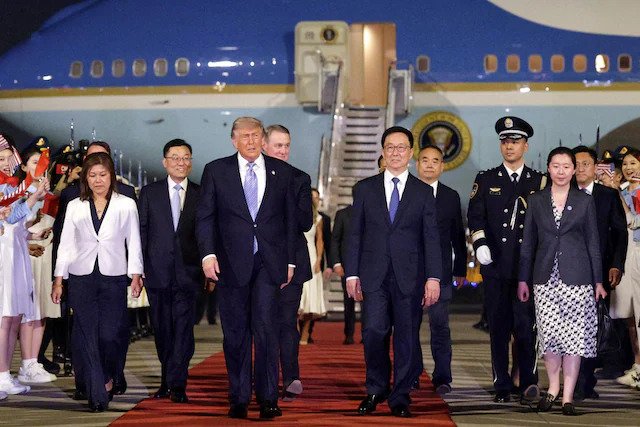
What is confirmed is that Trump arrived in Beijing for a closely watched summit with Xi, accompanied by senior U.S. officials and a large delegation of major business leaders from sectors including technology, energy, and manufacturing.
The visit marks the first presidential-level engagement in China in nearly a decade and is structured around a compressed set of high-level meetings, including a formal state reception and bilateral talks focused on trade, technology access, and geopolitical flashpoints.
The central economic focus of the talks is the fragile trade relationship between the world’s two largest economies.
Both sides are operating under a temporary trade truce that has reduced but not eliminated tariffs and export controls.
U.S. priorities include expanded access for agricultural exports, aircraft sales, energy shipments, and critical minerals.
China, in turn, is pressing for eased restrictions on advanced semiconductors and artificial intelligence-related technologies, which remain tightly controlled under U.S. export policy.
A major underlying driver of the summit is domestic political pressure on the U.S. administration.
Rising inflation concerns and economic disruption linked to broader geopolitical instability, particularly the ongoing conflict involving Iran, have increased incentives for the White House to demonstrate tangible economic wins.
This has shifted Trump’s messaging toward deal-making and stability rather than confrontation, even as internal political divisions persist over the risks of technology concessions and security trade-offs.
The summit also sits at the intersection of global energy and security tensions.
China remains a major buyer of Iranian oil, while the United States has increased pressure on global energy flows through sanctions and maritime enforcement.
These dynamics indirectly shape the negotiations, as both Washington and Beijing seek to prevent broader conflict from destabilizing energy markets and supply chains that are already under strain.
Technology competition is another core pillar of the talks.
Advanced semiconductors, artificial intelligence systems, and rare earth minerals are central to both economic competition and national security strategy.
U.S. companies face restrictions on exports to China, while Chinese supply chains remain deeply embedded in global manufacturing networks, creating mutual dependency that neither side is willing to fully sever.
Despite expectations of limited breakthrough agreements, both governments are signaling interest in maintaining structured engagement.
Proposals under discussion include formal mechanisms for ongoing trade coordination and possible sector-specific agreements, particularly in agriculture, aviation, and controlled technology flows.
However, structural disagreements over industrial policy and national security restrictions remain unresolved.
The summit ultimately reflects a managed rivalry rather than reconciliation.
Both governments are seeking short-term stability while preserving long-term strategic leverage, with economic interdependence constraining escalation even as political and technological competition continues to intensify.
The outcome is expected to shape not only bilateral trade flows but also global investment sentiment and supply chain planning across multiple industries.
The meeting concludes with both sides continuing negotiations through newly proposed institutional channels designed to keep trade disputes contained while preserving access to critical markets and technologies on both sides of the Pacific.
The meeting comes after months of trade friction, technological restrictions, and geopolitical spillovers from conflicts involving Iran, all of which have strained global markets and intensified pressure on both governments to stabilize ties.
What is confirmed is that Trump arrived in Beijing for a closely watched summit with Xi, accompanied by senior U.S. officials and a large delegation of major business leaders from sectors including technology, energy, and manufacturing.
The visit marks the first presidential-level engagement in China in nearly a decade and is structured around a compressed set of high-level meetings, including a formal state reception and bilateral talks focused on trade, technology access, and geopolitical flashpoints.
The central economic focus of the talks is the fragile trade relationship between the world’s two largest economies.
Both sides are operating under a temporary trade truce that has reduced but not eliminated tariffs and export controls.
U.S. priorities include expanded access for agricultural exports, aircraft sales, energy shipments, and critical minerals.
China, in turn, is pressing for eased restrictions on advanced semiconductors and artificial intelligence-related technologies, which remain tightly controlled under U.S. export policy.
A major underlying driver of the summit is domestic political pressure on the U.S. administration.
Rising inflation concerns and economic disruption linked to broader geopolitical instability, particularly the ongoing conflict involving Iran, have increased incentives for the White House to demonstrate tangible economic wins.
This has shifted Trump’s messaging toward deal-making and stability rather than confrontation, even as internal political divisions persist over the risks of technology concessions and security trade-offs.
The summit also sits at the intersection of global energy and security tensions.
China remains a major buyer of Iranian oil, while the United States has increased pressure on global energy flows through sanctions and maritime enforcement.
These dynamics indirectly shape the negotiations, as both Washington and Beijing seek to prevent broader conflict from destabilizing energy markets and supply chains that are already under strain.
Technology competition is another core pillar of the talks.
Advanced semiconductors, artificial intelligence systems, and rare earth minerals are central to both economic competition and national security strategy.
U.S. companies face restrictions on exports to China, while Chinese supply chains remain deeply embedded in global manufacturing networks, creating mutual dependency that neither side is willing to fully sever.
Despite expectations of limited breakthrough agreements, both governments are signaling interest in maintaining structured engagement.
Proposals under discussion include formal mechanisms for ongoing trade coordination and possible sector-specific agreements, particularly in agriculture, aviation, and controlled technology flows.
However, structural disagreements over industrial policy and national security restrictions remain unresolved.
The summit ultimately reflects a managed rivalry rather than reconciliation.
Both governments are seeking short-term stability while preserving long-term strategic leverage, with economic interdependence constraining escalation even as political and technological competition continues to intensify.
The outcome is expected to shape not only bilateral trade flows but also global investment sentiment and supply chain planning across multiple industries.
The meeting concludes with both sides continuing negotiations through newly proposed institutional channels designed to keep trade disputes contained while preserving access to critical markets and technologies on both sides of the Pacific.
AI Disclaimer: An advanced artificial intelligence (AI) system generated the content of this page on its own. This innovative technology conducts extensive research from a variety of reliable sources, performs rigorous fact-checking and verification, cleans up and balances biased or manipulated content, and presents a minimal factual summary that is just enough yet essential for you to function as an informed and educated citizen. Please keep in mind, however, that this system is an evolving technology, and as a result, the article may contain accidental inaccuracies or errors. We urge you to help us improve our site by reporting any inaccuracies you find using the "Contact Us" link at the bottom of this page. Your helpful feedback helps us improve our system and deliver more precise content. When you find an article of interest here, please look for the full and extensive coverage of this topic in traditional news sources, as they are written by professional journalists that we try to support, not replace. We appreciate your understanding and assistance.